
Prostate and bladder cancer
Private prostate and bladder cancer treatment, Liverpool and Wirral
I treat prostate and bladder cancer at every stage, using radiotherapy, hormone therapy, chemotherapy, immunotherapy and radioligand therapy, on their own or in combination, depending on which cancer you have and how it’s behaving. Each treatment plan is built around you: your diagnosis, your general health, and what matters most in your life.
If you’ve just been diagnosed with prostate or bladder cancer, or you’d like a second opinion on a treatment plan you’ve been offered, I’m happy to talk it through.

Private prostate cancer treatment, Liverpool and Wirral

Prostate cancer is the most common cancer in men in the UK It often grows slowly, and a number of the men I see have a cancer that needs watching rather than treating straight away, which is an unsettling thing to be told and takes some explaining.
Where treatment is needed, there’s usually more than one reasonable option. My job is to set them out honestly, including the trade-offs, and help you work out which fits your circumstances.
Coming to me for private prostate cancer treatment through the Clatterbridge Private Clinic can provide you with faster access to appointments and the latest treatments technologies and clinical research trials, many of which may not be available through the NHS.
What is prostate cancer?
The prostate is a small gland, about the size of a walnut, that sits just below the bladder and wraps around the tube you pass urine through. It helps make semen, and it’s normal for it to grow larger with age.
Prostate cancer develops when cells in the gland start growing in an uncontrolled way. It behaves very differently from one man to the next: some prostate cancers grow so slowly they may never cause any problems, while others grow more quickly and need treating. Your PSA level, the grade of the cells on biopsy and whether the cancer is contained within the prostate all help us work out which situation you’re in, and whether it needs treating now, or monitoring closely with treatment held in reserve.
Symptoms and diagnosis
Early prostate cancer often causes no symptoms at all, because it usually starts in the outer part of the gland. Many prostate cancers are found through a PSA blood test rather than because someone felt unwell.
Urinary symptoms, such as needing to go for a wee more often at night, difficulty getting started, a weaker flow than you’re used to, are far more commonly caused by benign enlargement of the prostate than by cancer. Less commonly, men notice blood in the urine or semen. None of these mean you have cancer, but they are worth getting checked.
Diagnosis usually involves a PSA blood test, an examination, an MRI scan of the prostate, and a biopsy if the MRI shows an area of concern. Further scans are sometimes needed to check whether the cancer has spread. If some of this has already been done by the time you see me, we’ll go through what it actually shows.
How prostate cancer is treated
There is rarely one ‘right way’ to treat prostate cancer. What I recommend depends on the stage and grade of the cancer, whether it’s confined to the prostate, your general health, any treatment you’ve already had, and what matters to you.
Not everyone needs treating straight away. For lower-risk cancers, active surveillance, (close monitoring, with treatment started if things change) spares you side effects from treatment you may not need to go through yet.
Where treatment is needed, the options I offer are external beam radiotherapy using IMRT/VMAT, hormone therapy, chemotherapy, radioligand therapy for selected men, or a combination of these. Surgery to remove the prostate is also well established; that’s carried out by a urological surgeon rather than by me, but I can work with your surgeon and other members of a multidisciplinary team on your treatment.
My job is to set out the reasonable options and explain the benefits and potential side effects of each, so you understand not just what I’d suggest, but why.
Private bladder cancer treatment, Liverpool and Wirral
Bladder cancer varies more than most people expect. Some bladder cancers sit only in the lining of the bladder and are managed with fairly straightforward treatment and regular checks; others have grown into the muscle wall and need a more intensive approach. Two people told they have bladder cancer can be facing very different plans, which is why understanding exactly what has been diagnosed matters so much.
As a clinical oncologist, my part of bladder cancer care is the radiotherapy and drug treatment, working alongside the urology team who handle the surgical side. Receiving private bladder cancer treatment from myself at the Clatterbridge Private Clinic provides patients faster access to appointments and the latest treatments, many of which may not be available through the NHS.
What is bladder cancer?
The bladder is a hollow, muscular organ that stores urine. Its inner lining stretches as the bladder fills, and it’s in the cells of this lining that most bladder cancers begin.
The key question is how deep the cancer has gone. Non-muscle-invasive bladder cancer is confined to the lining, or the thin layer of tissue just beneath it. Muscle-invasive bladder cancer has grown into the muscle wall and carries a greater risk of spreading. The distinction matters because the two are treated quite differently: non-muscle-invasive disease is usually managed by removing the growth and treating the bladder lining directly, with regular checks afterwards, while muscle-invasive disease needs more intensive treatment.
Symptoms and diagnosis
The most common symptom is blood in the urine. It’s usually painless, it can come and go, and sometimes it’s only picked up on a urine test. Other possible signs include needing to pass urine more often or more urgently, discomfort when doing so, or infections that keep returning.
Most people with blood in their urine don’t have cancer. Infections, stones and an enlarged prostate are all far more common. But it should always be checked, even once, and even if it settles on its own.
Investigation usually involves urine tests, a cystoscopy to look inside the bladder with a thin camera, and a TURBT under anaesthetic to remove and analyse any growth. Scans of the urinary tract complete the picture.
How is bladder cancer treated?
Treatment depends on whether the cancer is non-muscle-invasive or muscle-invasive, how the cells look under the microscope, whether it has spread, and your general health.
Non-muscle-invasive bladder cancer is usually led by the urology team. The growth is removed, and depending on the risk of it coming back this may be followed by chemotherapy or BCG given directly into the bladder, with regular cystoscopy checks afterwards.
For muscle-invasive bladder cancer there are two main approaches: surgery to remove the bladder, carried out by a urological surgeon, or radiotherapy given alongside a drug that makes it work more effectively, which allows the bladder to be kept. Both are well established, and for many people it’s a genuine choice rather than a fallback. Chemotherapy is sometimes given first to shrink the cancer.
If the cancer has spread beyond the bladder, treatment focuses on controlling it and keeping you as well as possible. Usually chemotherapy, immunotherapy, or both, with radiotherapy also very effective at relieving specific symptoms.
The radiotherapy and drug treatment is my part of your care. If surgery is the better option for you, I’ll say so, explain why, and work with the surgeon on providing pre- or post-treatment.
Treatments offered
Used on their own or in combination, depending on which cancer you have, how it is behaving and what matters to you.
Radiotherapy — external beam IMRT/VMAT
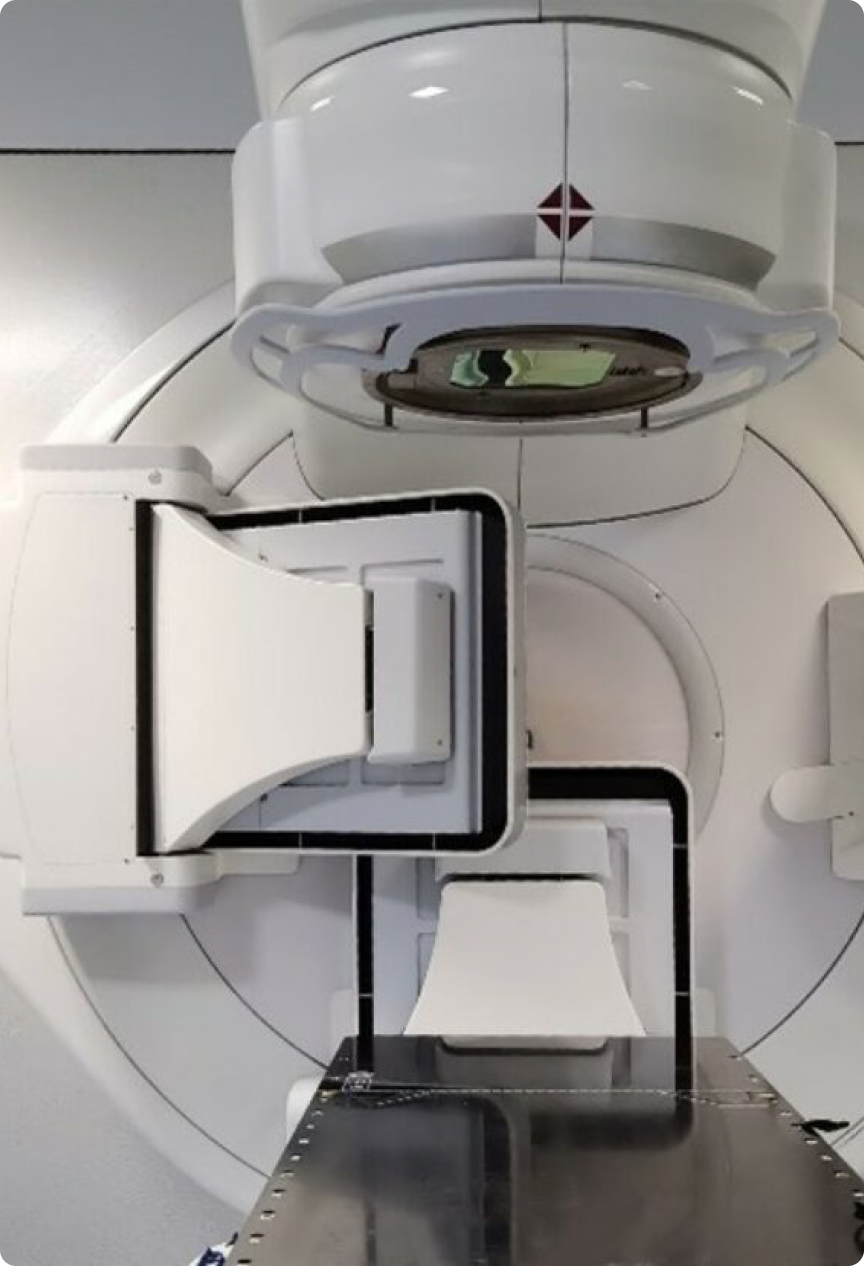
Radiotherapy uses targeted radiation to destroy cancer cells. External beam radiotherapy is given from outside the body by a machine that moves around you. It doesn’t hurt and you shouldn’t feel anything during treatment, and each session takes only a few minutes.
IMRT and VMAT shape the radiation dose around the area being treated, so more of it goes where it’s needed and less reaches healthy tissue nearby. I use both for prostate and for bladder cancer, and I’ll explain clearly what your course involves before we start.
Hormone therapy
Prostate cancer usually relies on testosterone to grow, so lowering the amount of testosterone in your body, or blocking its effect, can slow the cancer down or shrink it.
Some men have hormone therapy for a period alongside radiotherapy, because together they work better than either does alone. Where the cancer has spread, it can be a longer-term treatment in its own right. It does have side effects, and I’ll go through those properly rather than gloss over them.
Chemotherapy
Chemotherapy uses drugs that travel through the bloodstream to reach cancer cells wherever they are, given as a course of treatments spaced a few weeks apart.
In prostate cancer it’s generally used in more advanced disease. In bladder cancer it has wider uses: before surgery or radiotherapy, alongside radiotherapy to make it more effective, or on its own if the cancer has spread. Modern regimens are better tolerated than most people expect, and you’ll be monitored closely throughout.
Immunotherapy
Immunotherapy works differently from chemotherapy. Rather than attacking the cancer directly, it helps your own immune system to recognise cancer cells and act against them.
It has become an important treatment in bladder cancer and can be a valuable option for some people. Whether it’s right for you depends on the features of your cancer and the treatment you’ve had before, so it’s something we’d assess properly at your consultation.
Radioligand therapy
Radioligand therapy is a revolutionary newer treatment for prostate cancer, that is only available privately in certain forms e.g. with Lutetium-177 which carries a small amount of radiation directly to prostate cancer cells, using molecule that seeks out a protein found on their surface. It isn’t suitable for everybody. It’s used for selected men whose prostate cancer has spread and is no longer responding to hormone treatment, and a specialised PET scan called PET PSMA is needed first to confirm the cancer carries the target.
Early research has found it can not only help ease symptoms of advanced prostate cancer, but can provide men undergoing treatment with a better quality of life, so they can spend more time enjoying life with the people they love. We can work with local partners and Nuclear Medicine teams at Royal Liverpool to help deliver this.
Other bone targeted Radioligand treatment called Radium 223 can be given via the Private Clinic at Clatterbridge and be used in patients with advanced bony only disease that has spread and not responding to hormones helping with symptoms and quality of life
What to expect
From your first email through to follow-up, here is how a private consultation with me works.
01
Get in touch and arrange a referral
Email me with a little about your situation and a member of my team will come back to you. Cancer treatment will usually need a direct GP referral to me at the Clatterbridge Private Clinic, and my team will help you get that arranged.
02
Consultation
We’ll go through your diagnosis properly: your history, your scans and test results, and your circumstances. Bring someone with you if you’d like to, and ask as many questions as you like.
03
A treatment plan built around you
I’ll develop a treatment plan that is best suited to you and your condition, clearly explaining your options and potential outcomes and side effects. You’ll be part of that decision rather than on the receiving end of it, and you’re welcome to take time to think it over.
04
Treatment
If you decide to go ahead, I’ll plan your treatment and explain each stage before it happens. You’ll see me at every appointment rather than being passed between clinicians.
05
Ongoing review and follow-up
I’ll keep reviewing you during treatment and afterwards, and have regular one-to-one catch ups with you throughout so you can ask me any questions and discuss your treatment with me personally. You’ll also have a point of contact if something comes up between appointments.

Private medical insurance and self-funding options available
I see both self-funding patients and patients covered by private medical insurance, and I’m recognised by all the major UK insurers, including Bupa, Axa Health, Aviva, WPA and Vitality.
If you’re insured it is worth checking your policy and speaking to your provider before your first appointment, as cover for cancer treatment varies between policies. The private patient liaison team at the Clatterbridge Private Clinic can speak to insurers on your behalf to arrange payment for treatment too, so you don’t have to worry about it. If you’re paying for your own treatment, I’ll be clear with you about the costs and the team will go through all details with you.
Either way, get in touch with me today and I’ll help you to understand where you stand.





Get in touch to book a consultation
If you’ve recently been diagnosed, if you’re weighing up treatment you’ve been offered, or if you’d simply like a second opinion, I’d be happy to hear from you and arrange a consultation.
You don’t need to have your questions neatly worked out first. Send me an email with a little about your situation, and a member of my team will come back to you and help you with the next steps.
Dr Ian Lampkin
Consultant Clinical Oncologist
Liverpool · Wirral · Manchester
CLINICS
 Clatterbridge Private Clinic, Liverpool
65 Pembroke Place, Liverpool L7 8YA
Clatterbridge Private Clinic, Wirral
Clatterbridge Road, Bebington, Wirral CH63 4JY
Theralife Clinics – Manchester
Second Floor, Alderley Edge Medical Centre, Talbot Road, Alderley Edge, Cheshire, SK9 7HR
PROFESSIONAL
MBChB, MRCP, FRCR
Royal College of Radiologists
UK Imaging and Oncology Working Party
NICE committee for Prostate Cancer Diagnosis and Management
FRCR Part 1 Examination Board
© 2026 Dr Ian Lampkin. All rights reserved.
Registered with the General Medical Council, no. 7148965